Following my 2010 post, I thought I should register some of the great things that happened in the Perl programming world in 2011. Only this time instead of turning it into a timeline, I'm going to place things in topics so you can just concentrate on what really matters :)
Also, I'm only going to write about Perl 5. If you're looking for a Perl 6 retrospective, Moritz Lenz already did a very nice job with that :)
Apologies if I missed something - it's really hard to keep track of all the wonderful projects and conferences going on! Make sure to add them in the comments section below.
So, without further ado, here are the "Perls of 2011".
Some Perl & CPAN stats
According to Ohloh, over the course of 2011 there were nothing short of 5975 commits to the main Perl 5 repository. Wow! For comparison, Ruby had 3153 commits and PHP, 4461. We were a little short from our friends in the Python community, though, which had 6974 commits. Not bad, huh?
The Perl 5 bugtracking system reports a total of 915 tickets created in 2011, and 928 tickets closed in that same period. That was close, but the awesome folks at p5p once again managed to keep the stats positive :)
By the way, can you guess how many perl releases we had in 2011? 1? 3? more? 10? Try 21. Twenty one, including development and stable releases!
One of the coolest ones was, of course, perl 5.14, which brought us Unicode 6.0 support, new regex flags, the sugary "package Foo { }" syntax, improved IPv6 support and, as if these weren't enough, it uses even less memory and CPU than previous releases!
How about CPAN? 16197 distributions uploaded, of which 1873 were brand new!
Security
The Common Vulnerabilities and Exposures had 5 entries tagged "perl" in 2011, of which only 2 were actually regarding perl itself (namely, CVE-2011-0761 and CVE-2011-1487). Again, for comparison, python also had 2 records, ruby had 7, and php had 36.
Perl's commitment to stability and security was showcased in late december, when Alexander “alech” Klink and Julian “zeri” Wälde delivered a very nice talk at the 28th Chaos Communication Congress security conference in Berlin, entitled "Efficient Denial of Service Attacks on Web Application Platforms". Their work builds on top of an attack vector described in perlsec and fixed back in 2003 (the long-since-deprecated 5.8.1), and shows the issue affects almost every other popular language for the web, including Python, Java, PHP, ASP.NET and JavaScript. Ruby fixed their code in 2008 and people should be fine as long as they use CRuby 1.9 and above.
The King is dead. Long live the King!
For the past two years Jesse Vincent (obra) was our beloved Perl 5 Pumpking. Back in october he passed the torch to the incredibly prolific Ricardo Signes (rjbs), who will undoubtedly make us all very proud! A huge thanks is in order to both of them for the remarkable work they did last year - and that they'll undoubtedly keep on doing.
TPF Grants & Donations
Dave Mitchell once again did an astounding work with his "Fixing Perl 5 Core Bugs". Last year alone he worked more than 470 hours, closing 29 tickets. Great job, Dave!
In the middle of the year Nicholas Clark jumped on the wagon with his "Improving Perl 5" grant, approved with praise. So far Nick reported more than 380 hours of work, and tons of code to make Perl development even smoother.
None of this would be possible without the wonderful support from several companies that are proud to use Perl, giving out not only their public praise but also donating infrastructure and money to help further develop the language. This year we saw some incredible support from Booking.com, cPanel, Dijkmat, Liquid Web, Net-A-Porter, the Oslo Perl Mongers, perl-services.de, and the Vienna Perl Mongers.
Google Summer of Code (GSoC)
Every year The Perl Foundation participates on the Google Summer of Code program, and 2011 was no exception. This time, 6 students were accepted and all of them made their mentors proud - 100% success rate! A huge thanks is in order for everyone that participated.
Google Code-in
Another great initiative from Google in 2011 was the Code-in program, aimed at 13-17 year old school/college students with the idea of getting them involved with open source. The project is still running but we can already see some impressive results, such as over 135 completed tasks.
These numbers are great, and show that there's a big niche for Perl in schools and undergrad courses. I had the opportunity to teach Perl to undergrads in a one-week course at the Federal University of Rio de Janeiro and the receptivity was incredible! If you have the chance to give a short free workshop at your local college/university, I highly recommend you do so :)
Conferences! Conferences! Conferences!
All over the world, the vibrant Perl open-source community and their corporate sponsors filled the year 2011 with conferences showing the best modules, tools, techniques and design patterns, talking about a lot of bleeding-edge features and how to make Perl help with innovation and productivity for your enterprise.
January: Orlando Perl Workshop (OPW - a.k.a. The Perl Oasis)
February: Frozen Perl, Bulgarian Perl Workshop
March: Dutch Perl Workshop
April: Toronto Perl Workshop, QA Hackathon
May: São Paulo Perl Workshop
June: Nordic Perl Workshop, French Perl Workshop, YAPC::NA
August: YAPC::Europe
September: Italian Perl Workshop, Portuguese Perl Workshop
October: Ukrainian Perl Workshop, Pittsburgh Perl Workshop, Belgian Perl Workshop, German Perl Workshop, YAPC::Asia
November: YAPC::Brasil, TwinCity Perl Workshop, London Perl Workshop
December: Russian Perl Workshop
Only July had no perl-centric conference. Quite impressive! And we're not even counting general conferences in which we participated such as FOSDEM, FISL, OSDC, OSCON, or even Perl Mongers tech meetings. Speaking of which...
Perl Mongers
The number of active Perl Mongers group just keeps growing and growing. In 2011 alone, 15 new groups were spawned! Good luck to all our friends from AtlanticCity.pm (US), Makati.pm (PH), Bordeaux.pm (FR), HradecKralove.pm (CZ), Goiania.pm (BR), Petropolis.pm (BR), Brno.pm (CZ), Logan.pm (US), Tolyatti.pm (US), LGBT.pm, SouthernOregon.pm (US), Plzen.pm (CZ), Sendai.pm (JP), WestVirginia.pm (US) and Kerman.pm (IR).
With these new additions, our tiny planet hosts 251 active Perl Mongers groups :)
Prominent Perl People in 2011
This year we had some well-deserved White Camel Award winners: Leo Lapworth, Daisuke Maki and Andrew Shitov. Congratulations and thanks for making the Perl world better!
There are several others whom also deserve a huge praise for last year's work, amongst them Mark Keating of Shadowcat/EPO/TPF, who is tirelessly working on quality Perl marketing; Gábor Szabó who started the Perl Weekly mailing list and a series of Video Tutorials; and Thiago Rondon, who did huge things for the OpenData initiative, leading us (and Perl) into projects that added a lot of transparency to the Brazilian government and even resulted in a W3C Brazil OpenData Developer's Manual (of which I'm proud to have been a part of) and in winning the Latin America OpenData hackathon.
A couple of new, fun and downright useful websites were born in 2011, including Perl News by Dave Cross, Github-Meets-CPAN by Johannes Plunien; and PrePan, by Kentaro Kuribayashi. Important to notice that learn.perl.org was relaunched with a beautiful look and a lot of updated content. Great job, everyone!
But there are also the silent workers, the ones that are mostly behind the scenes but whose efforts were paramount for the Perl 5 ecosystem. People like Karen Pauley, president of The Perl Foundation; and Barbie, who worked really hard in keeping the incredible CPAN Testers service up and running.
In fact, a *HUGE* thanks are due to everybody involved in CPAN Testers in 2011: Barbie, Dave Golden, Chris Williams, David Cantrell, Slaven Rezić and just about everyone else. I had the great opportunity to help Dave Golden upgrade the cpan-reporter module to use metabase and I could see how intricate the whole thing is. By the way, did you know that in 2011 CPAN Testers crossed the barrier of over 1 million test reports in a single month? That's incredible!
Speaking of which, what would be of Perl 5 without its core developers? Several of them were already mentioned and praised here, but you can check the full list of contributors in the AUTHORS file, or in perldelta for a more recent list. This year we had the pleasure of seeing commits from Father Chrysostomos, Florian Ragwitz, H.Merijn Brand, Karl Williamson, Claudio Ramirez, Vladimir Timofeev, Nobuhiro Iwamatsu and many, many others. Thanks, guys!
Perl Games
The Perl gaming scene got yet another massive overhaul in 2011. Coming from all the hard work Kartik Thakore, Tobias Leich and everyone else at the SDL Perl project put in 2010, game development in Perl has never been this easy or fun.
The SDL Perl Manual was finished early in the year, and we were having so much fun we threw together the SDL Perl Game Contest in march, resulting in a total of 16 new games written from scratch in just one month!
The year also saw the coming of a Box2D wrapper for Perl, letting us add some fast physics to games and simulations.
But the best was yet to come. Construder, a jaw dropping 3D game created by Perl hacker Robin "elmex" Redeker, features futuristic settings with some nice graphics and an (almost) infinite world for you to build and play with. Make sure to check it out if you haven't already!
A Web of Perl
Perl's most widely adopted web frameworks also kept extremely busy, and 2011 marked some pretty cool releases and announcements:
Catalyst 5.9 was released back in august, incorporating Plack as its default Engine. This change benefits Catalyst significantly by reducing the amount of code inside the framework, getting upstream bug fixes in Plack, and automatically gaining support for any web server which a PSGI compliant handler is written for.
Mojolicious saw a total of 122(!) releases, including its 2.0 one, and now features updated websockets support, documentation enhancements and several asynchronous/non-blocking features. You can check out the official Mojolicious 2011 retrospective for the full monty.
The nice folks of Dancer started working on a massive core rewrite that will help the project tremendously. Among the changes being made, there will be no more globals in the core, 100% object-oriented backend, better scoping for sub-applications, and a better design overall.
Advent Calendars
The tradition remains, and the 2011 Perl Advent Calendars are filled with great content ranging from beginner tips to advanced hacks. The Japanese Perl Community once again delivered several high-quality articles in 9 different tracks, while the Brazilian Perl Community scattered their great articles throughout the two months of the Equinox.
Books
O'Reilly has been busy in 2011, with the updated 6th edition of Learning Perl - the Llama - by Randal Schwartz, brian d foy and Tom Phoenix, and Johan Vromans' handy Perl Pocket Reference. They're also getting ready for the 4th edition of Programming Perl - the Camel - to be released in early 2012. Heck, at O'Reilly they even used Perl to pick their Secret Santa :)
Speaking of upcoming titles, Ovid's Beginning Perl and chromatic's Little Plack Book are ones to keep an eye for. Who knows, maybe I'll get to talk a bit more about them in the 2012 wrap-up? I look forward to it!
Rise of The MetaCPAN
If you were one of the early adopters, you know MetaCPAN was actually born on late 2010 (november 3rd, to be precise). The project had some ambitious goals: provide a free and open sourced alternative search engine to the ever-glorious CPAN. But in 2011 it became more. So much more.
Moritz "Mo" Onken, a student at the Karlsruhe Institute of Technology (KIT), applied for the GSoC and quickly became a hero. Sure, he already had several years of Perl background, but what Clinton Gormley, Olaf Alders and himself achieved in 2011 exceeded all expectations and revolutionized the Perl world.
MetaCPAN is not only a sophisticated and fast CPAN search engine, but also offers a full featured REST API that lets you build on top of it making all sorts of complex search queries for extracting data from and about the CPAN. Another (very) important aspect: an active and vibrant community that actually encourages people to send patches fixing bugs and adding new features.
Featured Perl Modules
Wrapping up the retrospective, I should go about some of the cool new modules that spawned in 2011. This is not meant to be a thorough list, just a small snippet for your viewing pleasure:
Mason 2 - The traditional HTML::Mason distribution received a major overhaul and became just "Mason". The new distribution is being very actively developed and has a much more modern architecture. Check out the changes and give it a try!
dip - this nifty new tool offers dynamic instrumentation like DTrace, using aspects. Marcel Grünauer builds on top of Adam Kennedy's awesome Aspect Oriented Programming (AOP) Perl interface (that also reached 1.0 in 2011) to provide a tool that lets you change application's behavior without actually touching the source code. Very nice!
Lucy - David Wheeler released a nice Perl wrapper for Apache Lucy, a high-performance, modular full-text search engine library that assimilated the KinoSearch codebase and community.
Data::Printer - I don't like to talk about stuff I wrote doing general retrospectives, but I'm going to open an exception here. Data::Printer provides a simple and powerful - not to mention, colorful! - way to view your data structures. It's highly customizable and if you ever used Data::Dumper to view variable contents on the screen, you should give it a try :-)
There were also some visible trends on CPAN last year:
Towards a lighter Moose: everybody loves Moose (which also reached 2.0 in 2011!), but sometimes you just want - or think you just want - the sugary OO syntax, not the full-blown object system. Or maybe your particular environment doesn't let you install it, and you still need some small piece of it to make everything better. In 2011 there were a lot of uploads for Moose and Mouse alternatives, including Moo, Mo, and Mite. This definitely shows an itch that needs some scratching.
On a somewhat related note, Stevan Little is developing a proposal and a functioning prototype for a Meta Object Protocol, or MOP, to be perhaps included in a future version of Perl 5. Comments are welcome!
Sysadmin tools: Matt S. Trout took the time to bolt some modules together and bring us Tak, a multi-host remote control over ssh. But he wasn't the only one, and new sysadmin tools and modules sprouted all over the perlverse. Some fine examples include helm, providing easy server and cluster automation, and the great Rex (or, rather, "(R)?ex"), that lets you manage all your boxes from a central point through the complete process of configuration management and software deployment. Check out rexify.org for a quick glimpse of some of its features!
Simple ORMs: another trend in 2011 was to create simple DBI wrappers providing ORM-ish features, resulting in lightweight frameworks somewhere between DBI and DBIx::Class. Among the new distributions are Teng and DBIx::Sunny.
Dependency Managers: Finally, following Ingy's "only" pragma from back in 2003, a lot of effort has been put into making new and improved dependency managers for Perl applications and distributions. Miyagawa's carton and Gugod's perlrocks deserve particular attention.
That's it for this 2011 Perl retrospective. Hope you guys had as much of a nice time reading it as I had writing it. Let 2012 be the year of the Velociraptor!!
Tuesday, 3 January 2012

Monday, 30 May 2011
Data::Printer - a colored pretty printer for Perl
Wait, stop. Is this Yet Another Data::Dumper?
Well, yes and no. Data::Dumper (and friends) are meant to stringify data structures in a way that makes them still suitable for being eval'ed back in. That's really awesome, but poses a huge constraint over pretty-printers. Earlier this year, brian d foy talked about the amazing powers of Data::Dump, but it still suffers from those constraints. Same goes for the (also great) Data::Dump::Streamer.
Here's a quick visual comparison between the ever popular Data::Dumper and the new Data::Printer:

First thing you'll notice is the colored output, indexed arrays and a little extra regex information. But Data::Printer offers much more than that. How about debugging objects?

And what if your data is attached to others?

The idea behind Data::Printer is that most developers (at least to my experience) use such tools mostly just to see what's going on inside their variables and objects, not to serialize data in and out of Perl. So I decided to make a module that would focus on that: display Perl variables and objects on screen, properly formatted (to be inspected by a human). Data::Printer is somewhat similar to Ruby's "awesome_print", but I made sure to include more customization options and some neat features present in Perl's data dumpers.
For example, I called the printer function "p()" as it's nice and short and should steer clear of name collisions. But if you're so used to calling "Dumper()" in your code it just comes out naturally while you type, you can try this:
Data::Printer comes with (I hope!) very sane defaults, so usually all you have to do is "use Data::Printer" (or even shorter: "use DDP") and start peeking at data structures with the exported "p()" function. But pretty is a matter of personal taste, and from colors to array indexes to the hash separator and their default values, you can customize just about anything!
Sounds neat, but I'm not gonna type all that every time!
And you shouldn't - which is why Data::Printer looks for a file called
Filters
There are times when you don't really wish to see an entire object's internals during your review, just that important piece of information that you're holding in it. Data::Printer also offers you the ability to easily add filters to override any kind of data display:
If your filters are too complex you can create them as a separate module and load them by name. You can even upload them to CPAN so others can benefit from it! In fact, Data::Printer already ships with some (hopefully useful) filters for the whole DateTime family of modules (not just DateTime, but also Time::Piece and friends), and some Database ones as well (currently DBI and DBIx::Class):

You can also make your classes Data::Printer-aware simply by adding a _data_printer() function to them. You don't have to add Data::Printer as a dependency at all, and it will use that function to filter your class by default instead of doing a regular dump.
In Short...
If you want to serialize/store/restore Perl data structures, this module will NOT help you, and you should try other solutions such as the Dumper/Dump family, Storable, JSON, or whatever you can find on CPAN.
But if you only care about seeing what's going on inside your data structures and objects, give Data::Printer a try! Oh, and if you're into REPLs, you can add it as your default dumper for Devel::REPL too =)
Code is on github. Comments, feature requests, bug reports and patches are welcome!
Well, yes and no. Data::Dumper (and friends) are meant to stringify data structures in a way that makes them still suitable for being eval'ed back in. That's really awesome, but poses a huge constraint over pretty-printers. Earlier this year, brian d foy talked about the amazing powers of Data::Dump, but it still suffers from those constraints. Same goes for the (also great) Data::Dump::Streamer.
Here's a quick visual comparison between the ever popular Data::Dumper and the new Data::Printer:
First thing you'll notice is the colored output, indexed arrays and a little extra regex information. But Data::Printer offers much more than that. How about debugging objects?
And what if your data is attached to others?
The idea behind Data::Printer is that most developers (at least to my experience) use such tools mostly just to see what's going on inside their variables and objects, not to serialize data in and out of Perl. So I decided to make a module that would focus on that: display Perl variables and objects on screen, properly formatted (to be inspected by a human). Data::Printer is somewhat similar to Ruby's "awesome_print", but I made sure to include more customization options and some neat features present in Perl's data dumpers.
For example, I called the printer function "p()" as it's nice and short and should steer clear of name collisions. But if you're so used to calling "Dumper()" in your code it just comes out naturally while you type, you can try this:
  use Data::Printer alias => 'Dumper';

  Dumper( %foo );  # there, problem solved!
Data::Printer comes with (I hope!) very sane defaults, so usually all you have to do is "use Data::Printer" (or even shorter: "use DDP") and start peeking at data structures with the exported "p()" function. But pretty is a matter of personal taste, and from colors to array indexes to the hash separator and their default values, you can customize just about anything!
Sounds neat, but I'm not gonna type all that every time!
And you shouldn't - which is why Data::Printer looks for a file called
.dataprinter in your home directory and lets you keep all your preferred settings right there, so you only have to worry about it once :-)Filters
There are times when you don't really wish to see an entire object's internals during your review, just that important piece of information that you're holding in it. Data::Printer also offers you the ability to easily add filters to override any kind of data display:
  use Data::Printer filters => {
     'DateTime'      => sub { $_[0]->ymd },
     'HTTP::Request' => sub { $_[0]->uri },
  };
If your filters are too complex you can create them as a separate module and load them by name. You can even upload them to CPAN so others can benefit from it! In fact, Data::Printer already ships with some (hopefully useful) filters for the whole DateTime family of modules (not just DateTime, but also Time::Piece and friends), and some Database ones as well (currently DBI and DBIx::Class):
You can also make your classes Data::Printer-aware simply by adding a _data_printer() function to them. You don't have to add Data::Printer as a dependency at all, and it will use that function to filter your class by default instead of doing a regular dump.
In Short...
If you want to serialize/store/restore Perl data structures, this module will NOT help you, and you should try other solutions such as the Dumper/Dump family, Storable, JSON, or whatever you can find on CPAN.
But if you only care about seeing what's going on inside your data structures and objects, give Data::Printer a try! Oh, and if you're into REPLs, you can add it as your default dumper for Devel::REPL too =)
Code is on github. Comments, feature requests, bug reports and patches are welcome!
Friday, 13 May 2011
The *REAL* Perl Ironmen =)
Last Saturday (May 7) there was a huge Perl event in Brazil - the São Paulo Perl Workshop! It was a full-day conference with several awesome talks, featuring brilliant international keynotes like brian d foy, Brad Fitzpatrick and Larry Wall himself! The workshop also contained some of our local talent like Eden Cardim, Thiago Rondon and Solli Honório, and even talks from W3C and brazilian companies relying on Perl for their core businesses. We had around 100 attendants, making this one of the largest Perl events in the world!
But here's where it really heats up: We were on the Rio Perl Mongers mailing list, calmly discussing how to get to São Paulo for the workshop - you know, renting a bus, getting on the same flight, that sort of thing - when Diogo suggested we use other, less convenient, means of transportation.
Bicycles.
Now, for those of you that are unfamiliar with Brazil, here's a little geography lesson. It's the 5th largest country in the world, and although in adjacent States, the distance from Rio to São Paulo is over 480km (298.3 miles), most of it UPHILL. It beats NYC to Washington DC by 150km (93 miles), Tokyo to Kyoto by 110km (68 miles), and London to Paris by over 140km (87 miles)! Of course, being a mailing list of mostly brazilian people, we all knew that already. So when Diogo tossed in the air such an absurd idea, bearing on the clinically insane, there was only one thing we could do.
We said "Hell, yeah!!"
There were 4 of us in total for the adventure: MDA on the "safety car", Marcio, Diogo and myself riding the bikes. Marcio is actually from São Paulo, and would come to Rio by plane with his bike only so he could ride with us!
Plan and Preparations
A friend of mine is actually a professional trainer for a big team here in Rio, and agreed to help us get into shape and plan for the ride - granted, her wording was more in the line of "I'll do my best to help you not die", after a few minutes of screaming about how crazy we were. We only had two weeks(!!) to prepare so we'd need all the help we could get. Thanks coach!
Once we started taking it really serious and got our feet back on the ground, we realized there were some problems with the journey. Thing is, even at an extremely generous 25km/h rate (did I mention most of the way is uphill?) we'd still take over 20 hours straight to reach São Paulo. That's at least two days, and unlikely to happen. Getting the friday off was not that big a deal, but there was little chance we'd all be excused for thursday too. So we decided to cycle from 7am until it got dark, at which point we'd get in the safety car and finish the travel. After all, we had a Workshop to attend ;-)
Surely, nothing can go wrong! Oh, wait...
Marcio missed his flight, and had to travel by bus to Rio overnight. MDA faced a lot of traffic jams and we could only reach Marcio at the bus station by 9am. Then Marcio found out his bike's fork broke during the travel, and we had to find a place to quickly fix or replace it. With all that trouble, it was only 2pm when we finally hit the road!

On the highway, we started pedaling on the side of the road, and found out the hard way there were a lot of places with no "side of the road" at all! Whenever we found such places we had to get back in the car and wait until it was safe again. It was a nuisance, but no one had a death wish.


It was really scary to ride next to giant trucks and speeding cars, and to see several pieces of tire torn off from trucks on the way.

At some point we even had to quickly move to the "side of the side of the road" - whatever that means - to avoid being hit by a car traveling against the traffic, on our lane!!
Conclusion
It was a 4 hour ride and, albeit exhausted, we had a lot of fun! It was a nice opportunity to exercise outdoors, see some great sights and even raise awareness of the local IT community to the Workshop and to Perl itself - there was a lot of joking around because "camel" in portuguese is also a slang for bicycles =)
As a reward, we got the chance to be in a great workshop with fellow Perl hackers. Now who knows, maybe this november for the YAPC in Rio we'll travel back from São Paulo ;-)

Oh, and if you're interested in more pics of the journey and the conference itself, here they are :)
But here's where it really heats up: We were on the Rio Perl Mongers mailing list, calmly discussing how to get to São Paulo for the workshop - you know, renting a bus, getting on the same flight, that sort of thing - when Diogo suggested we use other, less convenient, means of transportation.
Bicycles.
Now, for those of you that are unfamiliar with Brazil, here's a little geography lesson. It's the 5th largest country in the world, and although in adjacent States, the distance from Rio to São Paulo is over 480km (298.3 miles), most of it UPHILL. It beats NYC to Washington DC by 150km (93 miles), Tokyo to Kyoto by 110km (68 miles), and London to Paris by over 140km (87 miles)! Of course, being a mailing list of mostly brazilian people, we all knew that already. So when Diogo tossed in the air such an absurd idea, bearing on the clinically insane, there was only one thing we could do.
We said "Hell, yeah!!"
There were 4 of us in total for the adventure: MDA on the "safety car", Marcio, Diogo and myself riding the bikes. Marcio is actually from São Paulo, and would come to Rio by plane with his bike only so he could ride with us!
Plan and Preparations
A friend of mine is actually a professional trainer for a big team here in Rio, and agreed to help us get into shape and plan for the ride - granted, her wording was more in the line of "I'll do my best to help you not die", after a few minutes of screaming about how crazy we were. We only had two weeks(!!) to prepare so we'd need all the help we could get. Thanks coach!
Once we started taking it really serious and got our feet back on the ground, we realized there were some problems with the journey. Thing is, even at an extremely generous 25km/h rate (did I mention most of the way is uphill?) we'd still take over 20 hours straight to reach São Paulo. That's at least two days, and unlikely to happen. Getting the friday off was not that big a deal, but there was little chance we'd all be excused for thursday too. So we decided to cycle from 7am until it got dark, at which point we'd get in the safety car and finish the travel. After all, we had a Workshop to attend ;-)
Surely, nothing can go wrong! Oh, wait...
Marcio missed his flight, and had to travel by bus to Rio overnight. MDA faced a lot of traffic jams and we could only reach Marcio at the bus station by 9am. Then Marcio found out his bike's fork broke during the travel, and we had to find a place to quickly fix or replace it. With all that trouble, it was only 2pm when we finally hit the road!
On the highway, we started pedaling on the side of the road, and found out the hard way there were a lot of places with no "side of the road" at all! Whenever we found such places we had to get back in the car and wait until it was safe again. It was a nuisance, but no one had a death wish.
It was really scary to ride next to giant trucks and speeding cars, and to see several pieces of tire torn off from trucks on the way.
At some point we even had to quickly move to the "side of the side of the road" - whatever that means - to avoid being hit by a car traveling against the traffic, on our lane!!
Conclusion
It was a 4 hour ride and, albeit exhausted, we had a lot of fun! It was a nice opportunity to exercise outdoors, see some great sights and even raise awareness of the local IT community to the Workshop and to Perl itself - there was a lot of joking around because "camel" in portuguese is also a slang for bicycles =)
As a reward, we got the chance to be in a great workshop with fellow Perl hackers. Now who knows, maybe this november for the YAPC in Rio we'll travel back from São Paulo ;-)
Oh, and if you're interested in more pics of the journey and the conference itself, here they are :)
Saturday, 30 April 2011
Catalyst in the Cloud
A lot of buzz was generated recently in the Perl community after DotCloud, a big PaaS player, introduced its brand new Perl stack, letting developers deploy modern Perl web applications into the "Cloud" without having to worry about the underlying system at all.
DotCloud already provides a nice Dancer example, and sri was diligent enough to provide a Mojolicious example as soon as he got his hands on an account. So when I got my own invitation to the service, I wondered how Catalyst would stand to the challenge.
After going through the whole thing in just a couple of minutes, all I can say is that:
If you were ever scared or concerned of using Catalyst due to its dependencies and how hard it would be to deploy... you're out of excuses =)
So, without further ado, here's the Catalyst DotCloud deploy process!
Install the "dotcloud" app in your local machine:
$ sudo apt-get install python-setuptools
$ sudo easy_install dotcloud
Create a DotCloud namespace (I called it "catalyst")
$ dotcloud create catalyst
Deploy a Perl stack into that namespace:
$ dotcloud deploy -t perl catalyst.www
Create a sample Catalyst app (skip if you already have one) and enter its directory:
$ catalyst.pl CatalystCloud
$ cd CatalystCloud
DotCloud uses the "static" dir for static files, so let's create a symbolic link there for Catalyst's root/static, or wherever else you placed your static files. There are probably other ways to customize this with DotCloud's standard configuration and its nginx server, but I just joined and haven't fiddled with any docs yet :)
$ ln -s root/static static
Add PSGI support for your Catalyst app. We could try the built-in FastCGI run script, but the recommended way is PSGI. To do that, simply install Catalyst::Engine::PSGI and create the new helper for your app, naming it "app.psgi" in your app's base directory:
$ cpan Catalyst::Engine::PSGI (or cpanm, or whatever you like)
$ script/catalystcloud_create.pl PSGI
$ ln -s script/catalystcloud.psgi app.psgi
The "app.psgi" file needs to know how to find your app, so add a use lib 'lib'; statement to it, right after "use warnings". The final file should look something like this (replacing "CatalystCloud" with your app's name, of course):
#!/usr/bin/env perl
use strict;
use warnings;
use lib 'lib';
use CatalystCloud;
CatalystCloud->setup_engine('PSGI');
my $app = sub { CatalystCloud->run(@_) };
Remember to add the new dependency to your app's Makefile.PL, so DotCloud knows what's required when it deploys:
requires 'Catalyst::Engine::PSGI';
Your application is ready; let's push it to DotCloud:
$ dotcloud push catalyst.www .
Now sit back and watch as DotCloud smoothly walks through all of Catalyst's dependencies and deploys your app to the Web. Sweet!
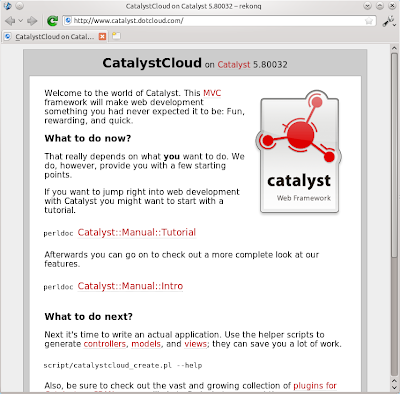
Once you start working on your application, remember to keep your Makefile.PL up-to-date, adding any and all dependencies to it (like Catalyst::View::TT and Catalyst::Model::DBIC::Schema). But you already do that, don't you?
If you run into trouble, give "dotcloud logs catalyst.www" a try (again, replacing the catalyst.www namespace with your app's) and browse through you application's logs in real time. If you left the -Debug flag on, you can even see Catalyst's messages on the fly.
Many thanks are in order to the ever-awesome Miyagawa and the whole DotCloud team for making deploying Perl applications such a breeze =)
Have fun!!
DotCloud already provides a nice Dancer example, and sri was diligent enough to provide a Mojolicious example as soon as he got his hands on an account. So when I got my own invitation to the service, I wondered how Catalyst would stand to the challenge.
After going through the whole thing in just a couple of minutes, all I can say is that:
If you were ever scared or concerned of using Catalyst due to its dependencies and how hard it would be to deploy... you're out of excuses =)
So, without further ado, here's the Catalyst DotCloud deploy process!
Install the "dotcloud" app in your local machine:
$ sudo apt-get install python-setuptools
$ sudo easy_install dotcloud
Create a DotCloud namespace (I called it "catalyst")
$ dotcloud create catalyst
Deploy a Perl stack into that namespace:
$ dotcloud deploy -t perl catalyst.www
Create a sample Catalyst app (skip if you already have one) and enter its directory:
$ catalyst.pl CatalystCloud
$ cd CatalystCloud
DotCloud uses the "static" dir for static files, so let's create a symbolic link there for Catalyst's root/static, or wherever else you placed your static files. There are probably other ways to customize this with DotCloud's standard configuration and its nginx server, but I just joined and haven't fiddled with any docs yet :)
$ ln -s root/static static
Add PSGI support for your Catalyst app. We could try the built-in FastCGI run script, but the recommended way is PSGI. To do that, simply install Catalyst::Engine::PSGI and create the new helper for your app, naming it "app.psgi" in your app's base directory:
$ cpan Catalyst::Engine::PSGI (or cpanm, or whatever you like)
$ script/catalystcloud_create.pl PSGI
$ ln -s script/catalystcloud.psgi app.psgi
The "app.psgi" file needs to know how to find your app, so add a use lib 'lib'; statement to it, right after "use warnings". The final file should look something like this (replacing "CatalystCloud" with your app's name, of course):
#!/usr/bin/env perl
use strict;
use warnings;
use lib 'lib';
use CatalystCloud;
CatalystCloud->setup_engine('PSGI');
my $app = sub { CatalystCloud->run(@_) };
Remember to add the new dependency to your app's Makefile.PL, so DotCloud knows what's required when it deploys:
requires 'Catalyst::Engine::PSGI';
Your application is ready; let's push it to DotCloud:
$ dotcloud push catalyst.www .
Now sit back and watch as DotCloud smoothly walks through all of Catalyst's dependencies and deploys your app to the Web. Sweet!

Once you start working on your application, remember to keep your Makefile.PL up-to-date, adding any and all dependencies to it (like Catalyst::View::TT and Catalyst::Model::DBIC::Schema). But you already do that, don't you?
If you run into trouble, give "dotcloud logs catalyst.www" a try (again, replacing the catalyst.www namespace with your app's) and browse through you application's logs in real time. If you left the -Debug flag on, you can even see Catalyst's messages on the fly.
Many thanks are in order to the ever-awesome Miyagawa and the whole DotCloud team for making deploying Perl applications such a breeze =)
Have fun!!
Friday, 25 February 2011
The SDL Perl Game Contest!
Sure, you know what SDL is, right? Well, SDL has very nice Perl bindings that let you use the power and flexibility of Perl to write awesome games in no time!
There's even a manual to help you get started, including full game tutorials and a list of free/open-source resources for your games, like sprites, sound effects and music.
But by far the Coolest Game Ever™ is the one *you* write, from that silly idea you had the other day to a playable game you and your friends can enjoy.
And this march, the SDL Perl team is going to help you take that project out of your dusty drawer of "TODO"s and turn it into a reality, with the SDL Perl Game Contest!
The rules are simple, and much like the Perl Ironman contest:
This means by the end of march you'll have not one, but FOUR games to show for. How cool is that?!
In fact, you can even make your weekly game the subject of your Ironman posts this month, and take out two birds with one stone (hmm... more game ideas)!
This monday (feb. 28), start writing your game! You have until the following monday to make it playable ("complete") and start all over again with a brand new game for the next week.
But what if I miss a deadline? What if I can't start this monday?
It doesn't really matter - just join the party and have some fun! Even if you only get to do one game, it's still a great opportunity to improve your skills and learn a bit about game design and development.
If you need any assistance writing your game, from ideas to code, WE WILL HELP! Just send an email to the SDL Perl mailing list with your questions (subscribe by sending an empty email to sdl-devel-subscribe@perl.org, then fire your questions to sdl-devel@perl.org) or, better yet, join us live in #sdl over at irc.perl.org and we'll be more than happy to assist you and try your game out. If you never used irc before, please keep in mind people might be busy or in different timezones than you, so you may get instant responses or have to wait a few of hours before you get a reply. Be patient!
It can be a game about anything. Just make sure it's doable in a week. Some games take years to be complete, but you might be surprised at how much you can accomplish in just a few hours with SDL Perl :)
Oh, there's one extra rule, actually, and that's mandatory - HAVE FUN!! :)
There's even a manual to help you get started, including full game tutorials and a list of free/open-source resources for your games, like sprites, sound effects and music.
But by far the Coolest Game Ever™ is the one *you* write, from that silly idea you had the other day to a playable game you and your friends can enjoy.
And this march, the SDL Perl team is going to help you take that project out of your dusty drawer of "TODO"s and turn it into a reality, with the SDL Perl Game Contest!
The rules are simple, and much like the Perl Ironman contest:
"One game per week. Every week of march."
This means by the end of march you'll have not one, but FOUR games to show for. How cool is that?!
In fact, you can even make your weekly game the subject of your Ironman posts this month, and take out two birds with one stone (hmm... more game ideas)!
This monday (feb. 28), start writing your game! You have until the following monday to make it playable ("complete") and start all over again with a brand new game for the next week.
But what if I miss a deadline? What if I can't start this monday?
It doesn't really matter - just join the party and have some fun! Even if you only get to do one game, it's still a great opportunity to improve your skills and learn a bit about game design and development.
If you need any assistance writing your game, from ideas to code, WE WILL HELP! Just send an email to the SDL Perl mailing list with your questions (subscribe by sending an empty email to sdl-devel-subscribe@perl.org, then fire your questions to sdl-devel@perl.org) or, better yet, join us live in #sdl over at irc.perl.org and we'll be more than happy to assist you and try your game out. If you never used irc before, please keep in mind people might be busy or in different timezones than you, so you may get instant responses or have to wait a few of hours before you get a reply. Be patient!
It can be a game about anything. Just make sure it's doable in a week. Some games take years to be complete, but you might be surprised at how much you can accomplish in just a few hours with SDL Perl :)
Oh, there's one extra rule, actually, and that's mandatory - HAVE FUN!! :)
Friday, 18 February 2011
Teaching Perl to Undergraduates
Perl is an amazing programming language. And, with its growing worldwide re-popularization, it was an easy sell to the Computer Science Department of the Federal University of Rio de Janeiro, one of the best and most famous universities in Brazil, when I offered to give a free Perl summer class to the undergrads.
The idea was to give students the opportunity to learn a new language, presenting the concepts, structure, best practices and design patterns of modern Perl 5. It was also my response to seeing so many companies here complaining about the lack of Perl developers, forcing them to use other languages even when Perl would be the best alternative for them.
And what a huge success it was!
The course was given by Bruno Buss and myself, with me doing the talk and him preparing and giving exercises to the students and helping them with their code. At first we were hoping to get about 10 students interested, specially since we didn't have time to advertise the summer class at all. In fact, due to uncontrollable events, we could only confirm it and open registration two weeks before the class itself started. Even so, we decided to carry on with it. Later that night I got a message from Buss: "we're gonna need a bigger room".
Turns out that in less than 24 hours we already had over 25 undergrad students registered for the course! We kept registration open as a waiting list, since we couldn't find an available lab with more than 25 PCs in such a short timeframe. A day before the beginning of the class there were over 50 students applying for a spot, even though they already knew the class was full!
And this is Perl competing against student vacations, during summer, in Rio.
The course was one week long, from 1pm to 5pm (yes, we had to compensate $dayjob during nighttime, but it was well worth it). Slides for all 5 days are available. It's mostly Perl, with a little Portuguese here and there like variable names, values and complementary information whenever necessary. Here's what we covered:
Students were mostly from Computer Science, with around 6 of them being from Biology/Biophysics/Bioinformatics, and one or two from Electric Engineering and Applied Mathematics. In the end, there were 27 undergrads. Yes, 27. It was very rewarding to see 2 booted students showing up anyway, with their laptops, asking if they could sit on the back and participate. Of course they could :)
The idea was to give students the opportunity to learn a new language, presenting the concepts, structure, best practices and design patterns of modern Perl 5. It was also my response to seeing so many companies here complaining about the lack of Perl developers, forcing them to use other languages even when Perl would be the best alternative for them.
And what a huge success it was!
The course was given by Bruno Buss and myself, with me doing the talk and him preparing and giving exercises to the students and helping them with their code. At first we were hoping to get about 10 students interested, specially since we didn't have time to advertise the summer class at all. In fact, due to uncontrollable events, we could only confirm it and open registration two weeks before the class itself started. Even so, we decided to carry on with it. Later that night I got a message from Buss: "we're gonna need a bigger room".
Turns out that in less than 24 hours we already had over 25 undergrad students registered for the course! We kept registration open as a waiting list, since we couldn't find an available lab with more than 25 PCs in such a short timeframe. A day before the beginning of the class there were over 50 students applying for a spot, even though they already knew the class was full!
And this is Perl competing against student vacations, during summer, in Rio.
The course was one week long, from 1pm to 5pm (yes, we had to compensate $dayjob during nighttime, but it was well worth it). Slides for all 5 days are available. It's mostly Perl, with a little Portuguese here and there like variable names, values and complementary information whenever necessary. Here's what we covered:
- Day 1 (slides) - What's Perl all about; how to use perldoc; the modern and safe header (use 5.12.3; use warnings); basic I/O; scalar variables; manipulating numbers and strings; conditionals; loops; and file I/O, with autodie to capture exceptions. We also spoke about the Perl community, showed off a bit of Padre, the Perl IDE, and encouraged students to use chromatic's brilliant "Modern Perl" book as reference material.
- Day 2 (slides) - Running external programs; arrays (and how to manipulate them); hashes (and how to manipulate them); scalar x list x void context. That, and lots of exercises to fixate what they learned so far.
- Day 3 (slides) - References; building complex data structures; functions (subroutines); stack traces with Carp and Carp::Always; and retrieving command line arguments with Getopt::Long. While explaining anonymous subs we also mentioned/demonstrated closures and state variables, but didn't really get into it as it was a beginners class. The day ended with an explanation of Perl's sweetheart, the CPAN. We showed students not only how to install modules (with local::lib), but included an explanation of the full CPAN stack, including web search, CPAN Testers, Deps, Ratings and Bug/Request Tracking. We also discussed how to exploit those features (and other common tips) to pick a good module (and, of course, Task::Kensho).
- Day 4 (slides) - Regular expessions; how to create modules and export functions; and more CPAN goodies, including Capture::Tiny to properly retrieve the output of external programs (and pretty much everything else); Try::Tiny to capture exceptions; DateTime to handle, well, dates and times; Path::Class to manipulate files and dirs; Config::Any and Log::Log4perl.
- Day 5 (slides) - Plain old documentation; writing tests; Perl Critic; Perl Tidy; Object Orientation (Moose only, including meta - I only mentioned bless as a curiosity, while explaining what happens under the hood); databases (nothing fancy, just plain DBI with a strong encouragement towards ORMs like DBIx::Class, Rose::DB::ObjectFey::ORM); Web Crawling with WWW::Mechanize and Mojo::Client; and Web development with Mojolicious::Lite, while also heavily encouraging them to try out Catalyst in their own time.
Students were mostly from Computer Science, with around 6 of them being from Biology/Biophysics/Bioinformatics, and one or two from Electric Engineering and Applied Mathematics. In the end, there were 27 undergrads. Yes, 27. It was very rewarding to see 2 booted students showing up anyway, with their laptops, asking if they could sit on the back and participate. Of course they could :)
Monday, 27 December 2010
A 2010 filled with Perls
2010 is almost over, and I figured it's time for a retrospective of yet another awesome year for the Perl programming language and its worldwide communities. I tried making this list as complete as possible, but it's of course my own point of view, so feel free to add anything you feel I've missed on the comments below, or in your own blog post.
So, without further ado, here are (my) highlights of the Perl world in 2010!
January
The year started with Perl Oasis, the traditional conference in Florida, USA, in a full day packed with great talks!
The Bulgarian Perl Workshop in Sofia also had some very nice practical talks about modern Perl topics.
Viacheslav Tykhanovskyi released Text::Haml, a Perl renderer for the increasingly popular Haml templates born in the Ruby/Rails world. The popularity is spreading fast, and there are already views for it in Catalyst, Mojolicious and Dancer.
February
Frozen Perl, a three-day event in Minnesota, USA, this year also had two Perl classes and a hackathon. Very nice!
On the other side of the world, the Perlburg Workshop in Yekaterinburg, Russia, was also packed with talks on several modern Perl topics.
The first version of perlbrew was released! What an amazing tool by Kang-min Liu, letting you manage several different perl installations in your home dir. Feels like forever, right?
How about cpanm, yet another incredible miyagawa-ware, proving to be an excellent lightweight alternative for installing Perl modules. It also made its debut to CPAN in February, and now you can even do curl -L http://cpanmin.us | perl - $MODULE. Soo sexy!
Tools like these two and local::lib make us wonder how did we live before them :-)
In fact, speaking of Miyagawa, man was he on fire or what this month?! February also marked the release of Starman, a high-performance preforking PSGI/Plack web server. It fits so nicely it's now used in production everywhere.
March
The Perl 6 Hackathon in Copenhagen, Denmark, raised a lot of awareness around Perl 6, showed practical examples and offered a hands-on experience to all attendants.
Perl also made a huge appearance in Germany at CeBIT, the world's largest computer expo, showcasing modern Perl solutions like Moose, Catalyst and DBIx::Class to over 8000 individual developers and companies from all around the globe, not to mention products such as Foswiki, and OTRS. Nice marketing, Perl::Staff! :-)
Moose 1.0 was released to the world! Now, I know Moose has been stable and production ready for a few years now, being the de-facto way to create and manipulate objects in modern Perl, and the only reason 1.0 was released was because they ran out of two-digit numbers. Either way, it looks nice and might make some enterprise people subconsciously more comfortable using it ;-)
March is the month of the first Equinox of the year, and the São Paulo Perl Mongers in Brazil celebrated the date with a calendar of Perl articles in portuguese, contributed by developers all over the country, just like the traditional advent calendars in december.
April
Perl 5 release 12 was finally out of the oven! And what a great improvement it was, with default strictness, Unicode overhaul, Y2038 compliance, pluggable keywords, and much more!
The Perl QA Hackathon in Vienna, Austria, gathered around 30 people in 3 full days of intense (and happy!) hacking, culminating in several improvements on the already great Quality Assurance tools for Perl, including Devel::Cover, Test::Smoke and Test::Harness.
Bugzilla 3.6 was released, offering exciting new features for users and administrators, including migration tools, a simple "Browse" interface, lots of usability improvements and drop-in extensions.
Josheph Hall and brian d foy did it again, and the second edition of Effective Perl Programming is better than ever, showing real problems and real solutions, just like the companion website. What are you waiting for, go get it now!
The unbelievably fast Text::Xslate templating system by Goro Fuji was released on an unsuspecting world. It's up to 158X faster (!!) than everyone's favorite Template::Toolkit, and provides a compatibility layer letting you use TT2's syntax and virtual methods if you want. Also, there are already views available for your Catalyst, Mojolicious and Dancer web apps.
May
DevConf, a major conference in Russia gathering over a thousand professional web developers, had a full track just for Perl!. And of course, the Russian Perl Community was amazing as usual and provided several nice talks for DevConf::Perl.
June
Wow, this month was filled with Perl conferences! Portuguese Perl Workshop, German Perl Workshop, Belgian Perl Workshop, each of them filled with nice talks and courses.
YAPC::Russia this year happened in Kiev together with Perl Mova, the Ukrainian Perl Workshop, and was another huge success.
And speaking of huge successes, June is not over until after YAPC::NA. The greatest Perl conference in the Americas happened for a full week in Ohio, USA, and had over 130 talks!
July
Following the mid-year sprint of Perl events, we also had the São Paulo Perl Workshop in Brazil, and the Warsaw Perl Workshop in Poland.
Rakudo Star was released! It's a useful - and usable! - implementation of the Perl 6 language specification.
Goro Fuji released the first version of Text::Clevery, a Text::Xslate subclass allowing developers using PHP's Smarty template syntax.

Gabriel Weinberg released DuckDuckGo's community website. I already wrote a bit about the amazing (and amazingly fast) DuckDuckGo search engine, and if you never used it, now is the perfect time. But beware: you might never return to Google search. I know I haven't ;-)
July also marked the second birthday of Padre, the Perl IDE. For a whole weekend, Padre developers, users, friends and well-wishers joined a huge party and hackathon.
FISL 11, the largest opensource event in Latin America, gathered over 7000 developers, enthusiasts and companies in Porto Alegre, Brazil. We had a very busy Perl stand there, and made a contest on the conference's big screen of an arcade zombie game developed live during the conference using SDL Perl. It was lots of fun!
August
YAPC::EU, "The Renaissance of Perl", joined Perl developers from all over the world in Pisa, Italy, with over 100 amazing talks and 14 tracks! They even had a cooking contest after the conference =P
September
JT Smith and crew released Lacuna Expanse, a highly addictive free massive multiplayer online (MMO) deep space empire strategy simulator (phew!) written in Modern Perl. It also has a public API, and people even hacked a new client for automated tasks. If you haven't played it yet, do it. Now. It's even integrated to Facebook, so if you have an account there, you don't even need to create a login.
Speaking of games, SDL Manual was started by Kartik Thakore in yet another grant by The Perl Foundation. It's not done yet, but it's the first real documentation of the new API, and already contains tons of code examples and complete game tutorials in Perl.
October
This month we had not one, but two other YAPCs!
The ever great YAPC::Asia in Tokyo went along for 3 days filled with the most awesome talks, and broke a new record: over 500 attendants!! How cool is that?!
On the other side of the world, YAPC::Brazil made its second appearance as a standalone conference in the beautiful city of Fortaleza, with around 100 of people attending online and on-site.
The Facebook SDK distribution was revived by Torsten Raudssus, giving a better overview on how to dive into the Facebook platform using the long existing modules to access the Facebook API via Graph or REST. Many Perl developers are active in social networks (writing robots for Twitter is a real breeze with modern Perl), so if you missed it now is the perfect time to get on board ;)
November
The Blekko search engine was released, offering a neat /slashtag syntax that lets you get the most relevant results in a heartbeat. It's great to see so many new companies relying on modern Perl for their core businesses. Give it a try, and slash the web!
Following the events calendar, the Austrian Perl Workshop opened november with a 2-day conference filled with great talks.
There was also Nordic Perl Workshop, organized by the Icelandic Society For Digital Freedoms in Reykjavik. It's the first time the NPW is held in Iceland, proving that volcanic eruptions may shut down an entire continent's airspace, but the camels will just keep strolling like it's a morning fog ;-)
With the second Equinox of the year, the São Paulo Perl Mongers arranged another sprint of modern Perl articles in portuguese, written by the entire Brazilian community.
Finally, after a lot of expectation from the worldwide Perl community, chromatic's Modern Perl book was finally out! As far as I can tell it's the best reference for modern Perl coding today, and an excellent read. I honestly think it's an amazing learning and reference material, and might prove insightful even to the most seasoned programmer. So go buy it now!
December
The always amazing London Perl Workshop happened on the 4th and proved once again to be an enormous success, including a talk by Spiros Denaxas about how Perl was used in medical research and epidemiology to help cure coronary heart disease.
On the 18th - Perl's birthday! - there was the Sixth Russian Perl Workshop, Saint Perl 2, in the lovely St. Petersburg, also filled with talks in Russian and English for all audiences, for free.
So, without further ado, here are (my) highlights of the Perl world in 2010!
January
The year started with Perl Oasis, the traditional conference in Florida, USA, in a full day packed with great talks!
The Bulgarian Perl Workshop in Sofia also had some very nice practical talks about modern Perl topics.
Viacheslav Tykhanovskyi released Text::Haml, a Perl renderer for the increasingly popular Haml templates born in the Ruby/Rails world. The popularity is spreading fast, and there are already views for it in Catalyst, Mojolicious and Dancer.
February
Frozen Perl, a three-day event in Minnesota, USA, this year also had two Perl classes and a hackathon. Very nice!
On the other side of the world, the Perlburg Workshop in Yekaterinburg, Russia, was also packed with talks on several modern Perl topics.
The first version of perlbrew was released! What an amazing tool by Kang-min Liu, letting you manage several different perl installations in your home dir. Feels like forever, right?
How about cpanm, yet another incredible miyagawa-ware, proving to be an excellent lightweight alternative for installing Perl modules. It also made its debut to CPAN in February, and now you can even do curl -L http://cpanmin.us | perl - $MODULE. Soo sexy!
Tools like these two and local::lib make us wonder how did we live before them :-)
In fact, speaking of Miyagawa, man was he on fire or what this month?! February also marked the release of Starman, a high-performance preforking PSGI/Plack web server. It fits so nicely it's now used in production everywhere.
Last but most certainly not least, David Mitchell submitted a grant proposal to The Perl Foundation, to fix bugs in core Perl 5. It was a huge success, and over the year he worked for more than 500 hours and closed 127(!!) tickets.
March
The Perl 6 Hackathon in Copenhagen, Denmark, raised
 a lot of awareness around Perl 6, showed practical examples and offered a hands-on experience to all attendants.
Perl also made a huge appearance in Germany at CeBIT, the world's largest computer expo, showcasing modern Perl solutions like Moose, Catalyst and DBIx::Class to over 8000 individual developers and companies from all around the globe, not to mention products such as Foswiki, and OTRS. Nice marketing, Perl::Staff! :-)
Moose 1.0 was released to the world! Now, I know Moose has been stable and production ready for a few years now, being the de-facto way to create and manipulate objects in modern Perl, and the only reason 1.0 was released was because they ran out of two-digit numbers. Either way, it looks nice and might make some enterprise people subconsciously more comfortable using it ;-)
March is the month of the first Equinox of the year, and the São Paulo Perl Mongers in Brazil celebrated the date with a calendar of Perl articles in portuguese, contributed by developers all over the country, just like the traditional advent calendars in december.
April
Perl 5 release 12 was finally out of the oven! And what a great improvement it was, with default strictness, Unicode overhaul, Y2038 compliance, pluggable keywords, and much more!
The Perl QA Hackathon in Vienna, Austria, gathered around 30 people in 3 full days of intense (and happy!) hacking, culminating in several improvements on the already great Quality Assurance tools for Perl, including Devel::Cover, Test::Smoke and Test::Harness.

Bugzilla 3.6 was released, offering exciting new features for users and administrators, including migration tools, a simple "Browse" interface, lots of usability improvements and drop-in extensions.
Josheph Hall and brian d foy did it again, and the second edition of Effective Perl Programming is better than ever, showing real problems and real solutions, just like the companion website. What are you waiting for, go get it now!
The unbelievably fast Text::Xslate templating system by Goro Fuji was released on an unsuspecting world. It's up to 158X faster (!!) than everyone's favorite Template::Toolkit, and provides a compatibility layer letting you use TT2's syntax and virtual methods if you want. Also, there are already views available for your Catalyst, Mojolicious and Dancer web apps.
May
DevConf, a major conference in Russia gathering over a thousand professional web developers, had a full track just for Perl!. And of course, the Russian Perl Community was amazing as usual and provided several nice talks for DevConf::Perl.
June
Wow, this month was filled with Perl conferences! Portuguese Perl Workshop, German Perl Workshop, Belgian Perl Workshop, each of them filled with nice talks and courses.
YAPC::Russia this year happened in Kiev together with Perl Mova, the Ukrainian Perl Workshop, and was another huge success.
And speaking of huge successes, June is not over until after YAPC::NA. The greatest Perl conference in the Americas happened for a full week in Ohio, USA, and had over 130 talks!
July
Following the mid-year sprint of Perl events, we also had the São Paulo Perl Workshop in Brazil, and the Warsaw Perl Workshop in Poland.
Rakudo Star was released! It's a useful - and usable! - implementation of the Perl 6 language specification.
Goro Fuji released the first version of Text::Clevery, a Text::Xslate subclass allowing developers using PHP's Smarty template syntax.

Gabriel Weinberg released DuckDuckGo's community website. I already wrote a bit about the amazing (and amazingly fast) DuckDuckGo search engine, and if you never used it, now is the perfect time. But beware: you might never return to Google search. I know I haven't ;-)
July also marked the second birthday of Padre, the Perl IDE. For a whole weekend, Padre developers, users, friends and well-wishers joined a huge party and hackathon.
FISL 11, the largest opensource event in Latin America, gathered over 7000 developers, enthusiasts and companies in Porto Alegre, Brazil. We had a very busy Perl stand there, and made a contest on the conference's big screen of an arcade zombie game developed live during the conference using SDL Perl. It was lots of fun!
August
YAPC::EU, "The Renaissance of Perl", joined Perl developers from all over the world in Pisa, Italy, with over 100 amazing talks and 14 tracks! They even had a cooking contest after the conference =P
September
JT Smith and crew released Lacuna Expanse, a highly addictive free massive multiplayer online (MMO) deep space empire strategy simulator (phew!) written in Modern Perl. It also has a public API, and people even hacked a new client for automated tasks. If you haven't played it yet, do it. Now. It's even integrated to Facebook, so if you have an account there, you don't even need to create a login.
Speaking of games, SDL Manual was started by Kartik Thakore in yet another grant by The Perl Foundation. It's not done yet, but it's the first real documentation of the new API, and already contains tons of code examples and complete game tutorials in Perl.
October
This month we had not one, but two other YAPCs!
The ever great YAPC::Asia in Tokyo went along for 3 days filled with the most awesome talks, and broke a new record: over 500 attendants!! How cool is that?!
On the other side of the world, YAPC::Brazil made its second appearance as a standalone conference in the beautiful city of Fortaleza, with around 100 of people attending online and on-site.
The Facebook SDK distribution was revived by Torsten Raudssus, giving a better overview on how to dive into the Facebook platform using the long existing modules to access the Facebook API via Graph or REST. Many Perl developers are active in social networks (writing robots for Twitter is a real breeze with modern Perl), so if you missed it now is the perfect time to get on board ;)
November
The Blekko search engine was released, offering a neat /slashtag syntax that lets you get the most relevant results in a heartbeat. It's great to see so many new companies relying on modern Perl for their core businesses. Give it a try, and slash the web!
Following the events calendar, the Austrian Perl Workshop opened
 november with a 2-day conference filled with great talks.
There was also Nordic Perl Workshop, organized by the Icelandic Society For Digital Freedoms in Reykjavik. It's the first time the NPW is held in Iceland, proving that volcanic eruptions may shut down an entire continent's airspace, but the camels will just keep strolling like it's a morning fog ;-)
With the second Equinox of the year, the São Paulo Perl Mongers arranged another sprint of modern Perl articles in portuguese, written by the entire Brazilian community.
Finally, after a lot of expectation from the worldwide Perl community, chromatic's Modern Perl book was finally out! As far as I can tell it's the best reference for modern Perl coding today, and an excellent read. I honestly think it's an amazing learning and reference material, and might prove insightful even to the most seasoned programmer. So go buy it now!
December
The always amazing London Perl Workshop happened on the 4th and proved once again to be an enormous success, including a talk by Spiros Denaxas about how Perl was used in medical research and epidemiology to help cure coronary heart disease.
On the 18th - Perl's birthday! - there was the Sixth Russian Perl Workshop, Saint Perl 2, in the lovely St. Petersburg, also filled with talks in Russian and English for all audiences, for free.
Perlbal::Manual, a complete manual for the highly used Perlbal reverse proxy and load balancer, was published by Bruno Martins and José Castro. Yay!
Mojolicious 1.0 was finally released, and it really makes web development fun - specially Mojolicious::Lite!
Speaking of fun lite web frameworks, the Dancer Advent Calendar made its debut this year, with several articles teaching you how to do things with Dancer, from testing and managing database connections to creating a tiny blog!
All other already traditional Perl, Perl6, Catalyst, RJBS's, and JPerl Advent Calendars are most definitively praise-worthy and were responsible for over 300(!!) new articles on Perl and its modules, with tons of awesome tips and cookbooks this month only! In fact, the Japanese Perl community is so freaking amazing they had 8 (that's right, EIGHT) tracks on their Advent Calendar, so JPerl alone was responsible for 200 articles this month. すごい!!
Wow, so much in just a year! I can't even begin to imagine all the wonderful things that are going to pop up in 2011!
See you there :-)
Subscribe to:
Posts (Atom)